
YC Summer 2026: the full batch, plus 7 of my favorites
All 234 publicly listed YC Summer 2026 startups, grouped by what they do, plus seven companies that caught Cathryn Lavery’s attention.
Sep 9, 2026
26 min read
I just spent the summer in San Francisco as a YC WAG. My wife’s company, RonanRX, got into the batch, and we had 4 weeks to relocate our family.
**YC Demo Day is tomorrow **🚀. I went through all 234 listed startups in the Summer 2026 batch to see what they actually do and which ones I’d use.
Yesterday was @ycombinator’s Alumni Demo Day.
Chris Lu compared Spring and Summer 2026. I visualized four of his findings below.
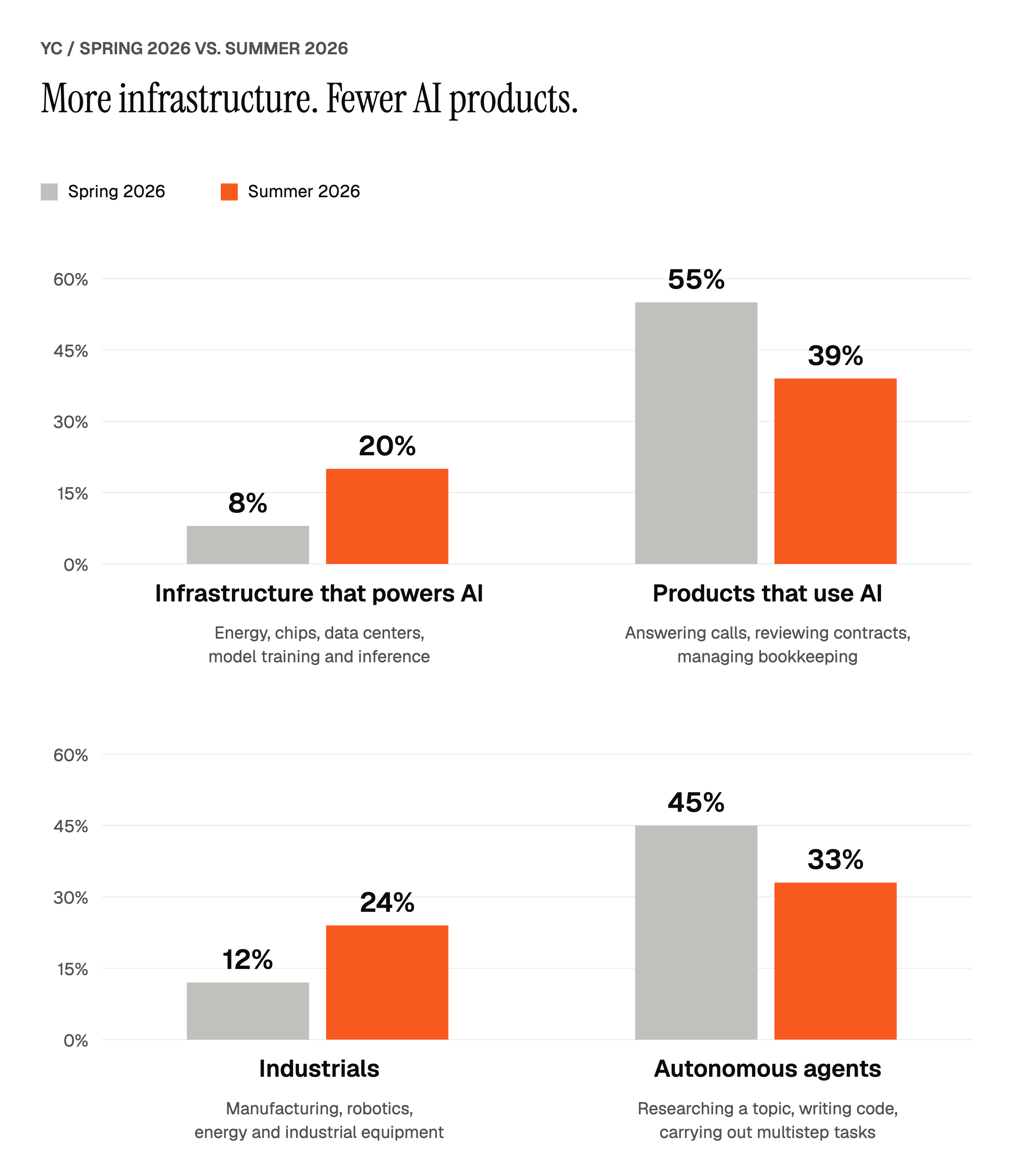
I grouped all 234 publicly listed S26 companies into 12 buckets based on their products and customers.
The count comes from September 9, 2026: YC calls them “launched companies” and says more may be added. This covers the full public directory on that date. Source: YC’s Summer 2026 directory.
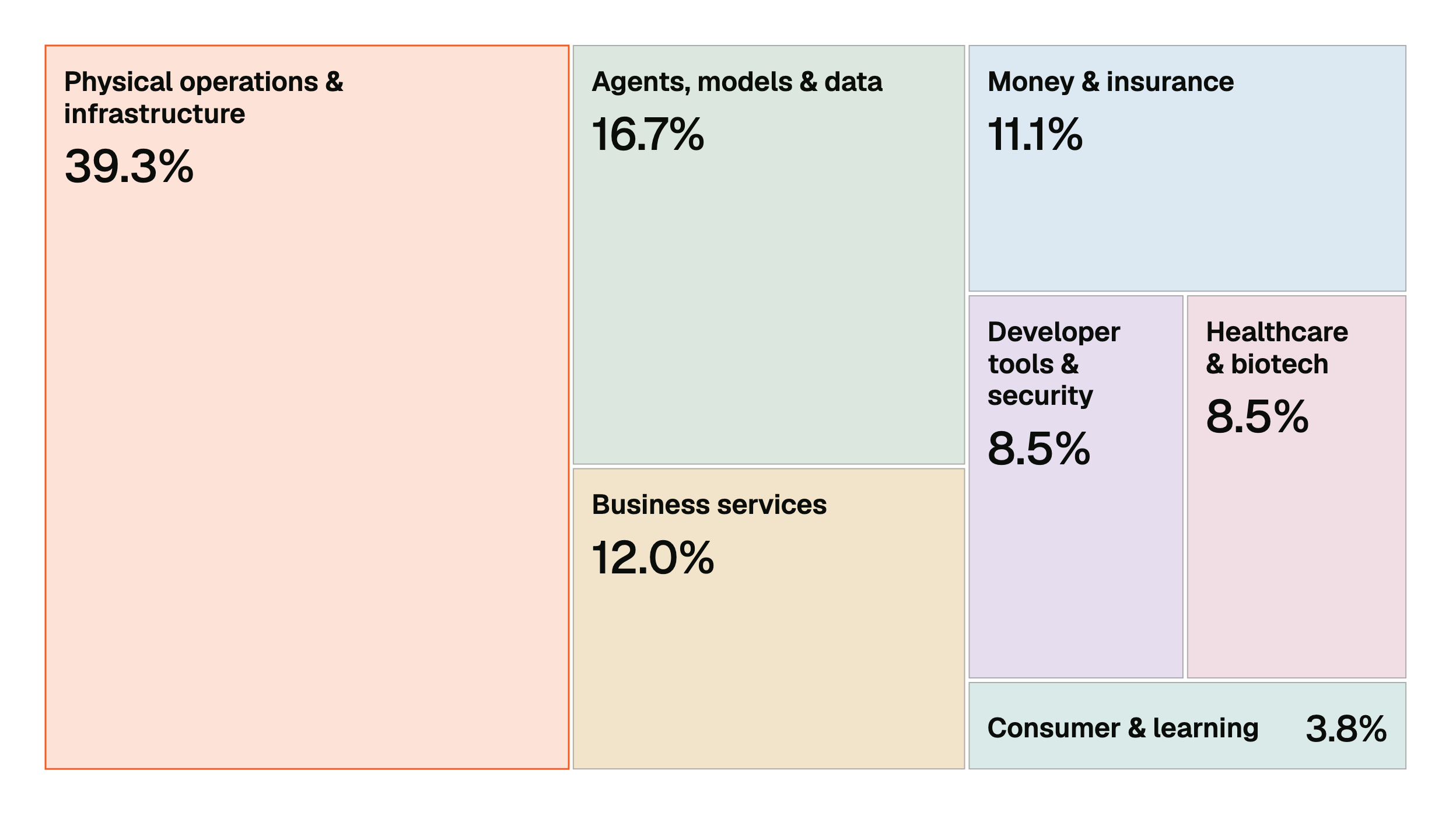
Here are 7 that caught my attention, followed by the full batch, grouped by the work they do.
7 that caught my attention
1. Nori: a $1,688 robot for chores at home and work
Nori’s public YC page lists a $1,688 robot and says it can fold clothes, clean rooms and restock shelves. You can also teach it tasks specific to your home or business.
A robot that folds my clothes for less than $2,000? Okay, now I want to see it. That’s the company’s description, so I’d want to see it handle a full load before handing over the laundry.
2. Context.dev: translating the web for agents
Context.dev takes information from websites and gives it to software and AI agents in a usable format. That can mean readable page text, specific fields you ask it to extract, or a company’s logos, colors and fonts.
It’s already part of my agent toolkit. The way I think about it: translating the web into something my agents can work with. For example, I could ask for product details from a page and pass those details into another tool.
If you’re not technical and want to become more technical, I made nontechnical.dev for you.
3. RonanRX: from factory to patient
RonanRX is building a full-stack pharmaceutical company, starting with personalized peptides and GLP-1s. The team built a pharmaceutical factory to make the medication itself.
The idea is to cut out middlemen by manufacturing the medication and selling directly to consumers through doctors. A doctor prescribes, a licensed pharmacist checks the medication, and the pharmacy ships it to the patient.
A founder building silicon-on-the-Moon manufacturing heard my wife explain the regulatory maze behind her pharmacy company. His reaction: “That’s really hard.” Then: “There’s no regulation in space.”
Disclosure: I’ve been working with this team. My wife, Emily (@emilyrcolman), and our friend Lloyd Armbrust (@larmbrust) started it.
4. Agent FM: one place to talk to my coding agents
Agent FM puts coding agents into one desktop group chat, with text and audio updates you can respond to.
Working with multiple agents makes this an easy one for me to be curious about. I’d like to try hearing what they’re working on and replying from the same place, especially when several projects are underway.
5. Screenpipe: turning computer work into something agents can learn
Screenpipe records how people work on their computers and turns it into searchable memory, documents and AI agents. The company says the data can stay on your device or wherever your team chooses.
I’d already used Screenpipe before YC, so I was happy to spot it in the batch. So much of a job lives in the way someone actually does it. That’s what interests me about giving agents access to that context.
6. Atomarine: nuclear-powered data centers at sea
Atomarine is developing data centers on floating barges, using seawater for cooling. It plans to manufacture the barges centrally and tow them to offshore sites.
The first planned pilot is gas-powered, with nuclear energy delivery ships as the longer-term plan. I’m interested in the physical problem behind this: finding enough power, cooling and space for the computers we’re asking to do more of our work.
7. Gamgee: cancer vaccines designed for individual dogs
I knew Paul Conyngham’s story before YC: he used AI and worked with UNSW scientists to design a personalized cancer vaccine for his dog, Rosie. I was excited to see him get into the batch.
Gamgee is developing personalized mRNA cancer vaccines for other dogs, with clinical trials underway in Australia.
What I noticed across the batch
I’m interested in how much of a business a small team can run well, and which of these companies could help. Some offer tools for the team; others take on work like importing or accounting.
I can picture buying those services for the same reason I build tools for my own team: to get more of the work handled without adding another thing for everyone to manage.
A few descriptions made me laugh because I’d built versions of those tools for myself. I built mine around my own work, so I’m curious to see how these teams make them useful to other people.
1. Agent infrastructure, memory and tools
These companies give agents somewhere to run, permission to use business tools and a memory of work already done. Some also route requests to cheaper models and use repeated tasks to train models a company can own.
Voice agents need those connections too: answering a call is only the beginning if the job involves changing a booking or updating a record.
- Almanac: An assistant that maintains shared work context and updates its own productivity tools.
- Amorphic Labs: A marketplace through which agents can find, pay for and use tools and data.
- Click: Research services inside ChatGPT and Claude that supply context from external data sources.
- Codag: An AI gateway that compresses tool responses and tracks and governs agent spending.
- Conifer: Routes AI requests across models, providers and caches to manage inference cost.
- Context.dev: An API that supplies agents with structured, current information from websites.
- Decawork: Trains company-specific models to approve or reject agent actions based on task context and policy.
- Dialogus: Infrastructure connecting enterprise voice agents to phone systems, business tools and human escalation.
- Dock: A shared workspace where people coordinate teams of AI agents.
- Egoist Machines: A portable personal context profile that users can carry across AI products.
- Executor: An open-source gateway that connects agents to APIs and other tools through a shared management layer.
- Experiential Labs: An open-source AI gateway that controls model access and uses production traffic to improve company-owned models.
- Glen: Shares context from agent sessions and company tools with agents starting new work.
- Inkbox: Gives agents persistent communication identities, including email and phone, plus agent-to-agent messaging.
- Jcode: Researches and builds the execution framework around AI models to improve agent performance.
- machine0: Cloud virtual machines that agents can create and operate through a CLI or tool connection.
- Mireye: An API connecting agents to fragmented geographic, infrastructure and other physical-world data.
- Mosaic: Shared memory and collaboration tools for teams working with coding agents.
- OneCLI: An open-source framework for team assistants with isolated workspaces and centrally controlled access to tools.
- OpenTag: AI coworkers in Slack and Teams that act on company context and keep shared knowledge up to date.
- Orchestra: An inference cloud that trains specialized models from work traces and deploys them after evaluation.
- Riften: Routes company AI traffic and uses that work to develop private, specialized models.
- screenpipe: Turns recordings of computer work into searchable memory, documentation and agents.
- Speko: Routes voice-agent requests among speech recognition, language and speech generation models.
- Tenor: Infrastructure for running AI-enabled service businesses, including shared data and governed workflows.
2. Model training, data and simulations
Training data here includes failed agent conversations, computer-use demonstrations and company records. Simulations give models tasks to practice, with the aim of improving each attempt.
I want to see whether that improvement holds when a new customer brings a different process. Getting better at a known task is useful, but it leaves plenty to prove about running a business.
- Agnost AI: Identifies failures in customer-facing agents and uses their interaction data to train specialized models.
- Belvedir: Trains and deploys private models, routing systems and agent frameworks from customer work traces.
- CoArena: A public arena that compares computer-use agents on real tasks and collects evaluation data.
- CueBench: Reinforcement-learning post-training for scientific reasoning and performance engineering; the public profile gives no further detail.
- hiloop: Runs research campaigns to improve agents and models against a customer’s measurable task.
- Induction Labs: Develops foundation models designed to learn through curiosity and interaction with the world.
- Magma: Helps companies monetize the records of work performed by their AI agents.
- Maingen: Builds industrial-operation simulations for training models to run facilities such as factories and power plants.
- Markov: Supplies expert computer-use demonstrations for training frontier AI models.
- Olam Labs: Multi-agent simulated environments for evaluating and training social and strategic behavior.
- Ooak Data: Turns internal company data into environments for training and testing agents on real work.
- Petrarch: Sources and prepares industrial companies’ internal records for AI model training.
- rekursiv.ai: Develops AI scientist teams that conduct experiments and use discoveries to improve subsequent research.
- Tracer: Researches ways to combine open-source models for more capable and efficient AI.
3. Developer tools and cybersecurity
Much of this group deals with the work that follows a request to write code: finding dependencies, coordinating agents, testing changes and investigating production failures.
Producing more code means budgeting for inspection, maintenance and repairs. Security controls also need to hold when an agent receives bad instructions or encounters hostile input.
- Agent FM: A desktop group chat for monitoring and directing multiple coding agents through text and audio.
- Akon Labs: Builds GitNexus, which maps code dependencies and execution paths into knowledge graphs for coding agents. Company website.
- Alkera AI: Data engineering and analysis agents that use data lineage and company context.
- Archal: Resettable API environments and sandboxes for coding-agent tests and evaluations.
- Buildbox: Analyzes user intent and agent behavior to identify product failures and prioritize fixes.
- Caution: Hosts software in secure computing environments with cryptographic evidence of what code is running.
- Fabraix: Automated adversarial testing to find security weaknesses in AI agents.
- GitCafe: Git hosting and development infrastructure designed for large volumes of agent-generated work.
- Graphify Labs: Knowledge graphs for code and company documents, with change review and formal verification tools.
- Hoplite: Tools for deploying cloud software factories; the public profile does not explain the product in detail.
- HyperProbe: Gives agents runtime information from live software to investigate and fix production failures.
- Mentlio: Connects engineering AI spending to delivery and reduces usage through routing and context management.
- Nebula Security: Develops AI-powered cyber defense and provides security auditing expertise.
- Palisade (device security): AI for finding and fixing operating-system vulnerabilities across device fleets; the public profile gives no further detail.
- Prized: Persistent cloud development machines with files and ports accessible from a local Mac.
- Rindler: A desktop workspace for overseeing multiple coding-agent sessions and coordinating their work.
- Traceforce: Monitors how employees and agents use AI applications to detect and prevent unsafe actions.
- Trident: Security-testing agents that trace exploitable attack paths across cloud systems, applications and APIs.
- Vendo: Lets a software product’s users build custom features and automations on top of its existing APIs.
- Verdict Machine: Models financial institutions’ digital-asset environments to assess cyber risk and check transactions against policy.
4. Accounting, legal and government work
The work ranges from accounting and invoice follow-up to law-firm operations. Human involvement varies: one accounting firm keeps a certified accountant’s sign-off, while another aims to run entirely on agents.
I want to know who fixes the books when an invoice doesn’t match. How much chasing the customer still has to do is a better way to compare these offers than the word “autonomous” in a pitch.
- Assemble: Agents that help IT teams plan, build and validate changes inside core business systems.
- Async: Agents for running operational work in small service businesses.
- Billow AI Labs: Handles accounting and financial planning work across existing business systems and spreadsheets.
- Cerenovus: Reads company records to identify operational problems and prioritize possible improvements.
- Chromie: Software that helps businesses pursue and manage government contracts.
- Definite: A read-only financial data layer on which teams can build back-office agents.
- Erinys: Provides technology, intake and business operations for lawyers starting or expanding their own firms.
- Last Accounting Company: An accounting firm where agents do bookkeeping and tax work and a certified accountant signs off.
- Locke: Builds agents for government work and operates an AI-enabled government affairs firm.
- Luca IQ: A tax calculation and electronic filing API for accounting firms and developers.
- Marker: A platform and implementation team for rebuilding enterprise workflows around agents.
- Perceptron ML: Private AI systems for law firms covering matters, research, discovery and drafting.
- Rational: Building an accounting firm whose AI agents handle intake, bookkeeping and tax filing.
- Rex: An AI-operated service managing invoices, follow-ups and exceptions in order-to-cash work.
- Trope: Builds and deploys customized AI agents inside companies’ enterprise resource planning systems.
- Verdant: Software and agents for local government workflows, starting with permitting.
5. Sales, customer research and hiring
The jobs here include finding candidates and booking visits from local creators, alongside customer research and sales outreach. I grouped them by that work because “marketing AI” tells me very little about what I would be buying.
A completed creator visit or a qualified sales opportunity gives the business something it can evaluate. For the products that learn from results, I want to know how they connect those outcomes back to the work that produced them.
- COACH: Analyzes in-person sales conversations to coach reps and capture company knowledge.
- Grocalo: Uses audience analysis to create, personalize and distribute content for creators.
- LATO: Combines market research and interviews with simulations of how market participants may behave.
- LemonLime: Prepares leads, outreach and marketing content for small businesses, with users approving sends.
- Litmus: Builds evaluations of human capability, starting with software work alongside AI.
- Nex: Builds and runs complex sales and marketing workflows using AI.
- Palisade (marketplace sales): Personalized sales agents for visitors to online marketplaces.
- Pluto: Uses career interviews to build searchable professional profiles for recruiting.
- Poth Labs: Combines company data and user feedback to investigate customer behavior and business problems.
- Studio: Models audience behavior to simulate how markets may respond to new products or ideas.
- TryNearby: Matches local businesses with nearby creators and coordinates promotional content visits.
- Tsenta: An assistant that finds matching jobs and applies on a job seeker’s behalf.
6. Money, markets and insurance
This group includes underwriting tools and insurance carriers taking on risk themselves. Others handle financial institutions’ review work, including compliance checks and disputes.
There are also markets for future inference capacity and GPU trading. I would compare these businesses by what the customer is purchasing and who carries the cost of a bad decision.
- Agentcard: Debit cards and an API that let AI agents make online purchases.
- Arbital: A trading platform combining stocks, crypto and perpetual contracts with social features.
- Audun: An AI-enabled debt collection company.
- Callbook AI: An AI-operated collections agency that contacts and negotiates with borrowers on late-stage debts.
- Computable: Developing a derivatives exchange for compute; the public profile gives no further detail.
- Denta: A dental insurance carrier selling to employers and using AI for claims processing.
- EdotEnv: Uses quantitative finance as a testing and training environment for self-improving research agents.
- Ekpa: Autonomous research agents for trading; the public profile gives no further detail.
- Financial Datasets: Market data and financial research infrastructure built for AI agents.
- Florin: An insurance carrier using AI to investigate, underwrite and price risks.
- Insurf: Data and decision tools for comparing health insurance coverage and costs.
- Levocred AI: AI tools for lenders to price loans and manage their loan books.
- Lyon: Private models trained on financial institutions’ transaction data for risk and customer predictions.
- Pennant: Voting and corporate-governance intelligence for investors, public companies and advisers.
- Prescience, Inc.: A health benefits platform using AI to operate employer health plans and coordinate care.
- PRINCEPS: Insurance for data centers and compute providers, including outage and hardware-value risks.
- Prodigy Research: Develops models and research systems for quantitative trading.
- Qlo: AI agents and workflow infrastructure for commercial insurance underwriting.
- Rapidfolio: Automates bank and fintech back-office work, including identity reviews, fraud investigations and underwriting.
- Risklytics: Insurance for frontier technology businesses, including robotics and data centers.
- Spectre Intelligence: A trading firm that develops AI traders.
- Stoa: Pricing and trading infrastructure for AI hardware, including a marketplace for GPUs.
- tash: Developing an investment platform for professionally managed sports and trading-card portfolios.
- Touchmark: A marketplace for buying and reselling future AI inference capacity.
- TovenAI: AI agents for compliance workflows at institutional trading firms.
- Zomma: Computer-use agents for financial-service operations such as identity checks, alerts and disputes.
7. Healthcare, pharmacy and biotech
Retrieving a patient’s records and developing a treatment are very different jobs. This group includes care providers and the software around them, with different customers and evidence requirements for each.
I care about whether the steps connect: a faster intake form does little for someone whose appointment or records are still stuck. These descriptions explain the products and development goals; clinical effectiveness requires separate evidence.
- Allia Health: An AI-enabled mental health medical group that brings practices onto a shared clinical system.
- Atlas Discovery: Develops agents for drug repurposing and clinical-trial operations. Company website.
- Avoca Systems: Automates patient access for radiology networks, including referrals, scheduling and follow-up communications.
- Care GP: AI agents for the operational work of primary care clinics.
- Cova: An AI-enabled home care agency that also helps family caregivers access payment programs.
- Elite: Voice agents that handle healthcare front-office tasks and update practice systems.
- Evergrove: Voice agents for coordinating workers’ compensation care and related healthcare workflows.
- Floracene: A platform for healthcare teams to build and deploy internal tools with controlled data access.
- Gamgee: Developing personalized mRNA cancer vaccines for dogs using genomic analysis.
- Gutgutgoose: Uses gut sequencing and metabolic modeling to develop personalized probiotic formulations.
- Hubble: An API that retrieves medical records, including from providers that still require calls and manual interaction.
- Illume Labs: An AI health companion that combines wearable, laboratory and genomic information.
- Lumeria: A phone-mounted skin imaging device and software for tracking changes over time.
- Omanta: Runs individualized research programs for patients with unresolved diagnoses or limited standard treatment options.
- Osseus: Supplies medical and biological datasets and training environments, alongside software for clinical workflows.
- Radley: An AI-enabled radiology practice rebuilding clinical business operations around agents.
- RonanRx: A pharmaceutical company combining clinician-reviewed prescribing, manufacturing and delivery, starting with personalized peptides and GLP-1s.
- Sunflower: Building a telemedicine clinic for addiction, alongside an AI recovery-support app.
- TareBio: Developing vaccines by studying disease-fighting immune cells and working backward to relevant antigens.
- WonderTx: Discovers oral drug candidates aimed at biological targets already addressed by injectable medicines.
8. Robots and the systems that teach them
Robots here sort waste, run wet-lab experiments and install construction materials. I included the companies that supply their training data, testing and software updates. Military systems have a separate section.
The test for a factory robot is whether it keeps doing the job after the person who set it up has gone home. That makes training and maintenance part of the product an operator has to assess.
- 6thSense: Tactile capture hardware, including gloves and robot-hand skin, for collecting manipulation training data. Company website.
- Agency Tool Company****: Tools for deploying robot software and testing it on the target computing hardware.
- Aktoria Robotics: Remote human operation of robots; the public description provides limited implementation detail.
- Cosmic Robotics: Builds heavy-lifting construction robots, starting with solar panel installation.
- Datoric: Researches, collects and verifies custom training datasets for robotics, world models and voice models.
- DeepReach Inc.: A network and wearable capture devices for collecting real-world physical-work data.
- Enact: Physical environments and training loops for benchmarking and improving robotics models.
- Grip: Robotic sorting and manipulation for waste and recycling, starting with organic waste.
- Hebbian Robotics: APIs that check the quality of robotics training data.
- Libra Robotics: Collaborating robot crews for large infrastructure construction projects.
- Manifold: Deploys warehouse robots for picking, loading and palletizing, with pricing tied to completed picks.
- Most Robotic: A robotics research lab focused on household automation; its public description gives limited product detail.
- Moving Atoms: Simulation models that let robotics teams train against virtual physical environments.
- Neuromorphic: Builds robots to carry out experiments using existing wet-lab equipment and workstations.
- Nori: A mobile robot advertised at $1,688 that the company says can fold clothes, clean rooms and restock shelves, with software for teaching it new tasks.
- OS3: Builds and deploys mobile robots with an integrated hardware, model and control system.
- Praxis Robotics: Collects video, spatial and other training data inside real businesses for robotics developers.
- Proprio Robotics: Developing robots for data center construction, maintenance and decommissioning.
- Robocurve: Independent benchmarks and open-source tools for evaluating robots on physical tasks.
- Salem Robotics Inc: Deploys robots to perform inspections, measurements and compliance surveys in hazardous facilities.
- Shiraz AI: Deploys factory robots designed to learn new tasks from human demonstrations.
- Tensr: Operates automated manufacturing facilities that build robots and robotics components.
- Waddle Labs: Language models for controlling robots; the public profile gives no further detail.
9. Factories, logistics, construction and property operations
The largest group covers sourcing parts, managing freight and closing property sales. This work relies on information scattered across documents, equipment and people’s heads.
Some sell software to existing operators; others become the importer, broker or property manager. With the service, I am paying someone to resolve the handoffs as well as provide the system.
- Alloovium: Reads construction documents to answer questions, check paperwork and support approved actions.
- Applied Electrodynamics, Inc.: Imaging systems for detecting structural elements and utilities inside walls and ceilings.
- Atlia: A short-term rental property management company using agents to run operations.
- Axelrod: Software designed to handle hotels’ front-office and back-office operations autonomously.
- Bernard: Agents for appliance service businesses that coordinate bookings, diagnosis, parts and technician handoffs.
- Bizmark: Agents that learn and carry out factories’ daily management work.
- CarSignal: Connects diagnosis, repair information and shop workflows for independent auto repair businesses.
- Control Seat: Connects industrial control, monitoring and machine-health information into a shared operational system.
- Daqstra: Connects hardware test equipment and data through an API for managing physical R&D.
- Dawn Industries: Connects industrial machines and sensors to diagnose faults and prepare operator-approved fixes.
- Derya: AI-assisted industrial trade and supply-chain operations, from sourcing through distribution.
- Donkey: A trading company that sources and delivers imports under a single purchase contract.
- Dream: Camera systems that record vehicles and equipment and flag changes in their condition.
- Edviro: Connects to energy equipment to diagnose problems, coordinate maintenance and control authorized operations.
- Ekho Labs: Models geopolitical and trade disruptions to identify exposed freight shipments and possible responses.
- FlowManual: Automates construction estimating, bidding and purchasing for contractors.
- HERA: Engineering tools for manufacturers developing complex industrial equipment.
- Hilstart: Physical testing infrastructure that lets agents debug and validate hardware and software.
- Kebra: Guides skilled technicians and automates associated dispatch, warranty and inventory work.
- Marble: Restaurant back-office software connecting inventory, demand forecasting and operational workflows.
- Marengo: An engineering firm using AI to design data centers.
- Neuron Industries: Industrial controllers designed to support AI-driven machine and factory operations.
- OpenVector: Connects camera feeds to vision models and agents that act when specified events occur.
- Pango: Lets ecommerce teams build agents for logistics tasks, including delivery and returns.
- Peer: An AI-enabled freight brokerage managing quotes, carrier matching and shipment coordination.
- RealPact: Agents that gather property records and manage real estate transaction paperwork.
- Shielded: Maps trade disruptions and market changes to suppliers, products and financial exposure.
- Sidekick: A text-message agent that answers factory questions, routes work orders and flags equipment issues.
- Skymerse: Develops AI for airline flight planning, operational monitoring and cockpit support.
- SpaceFlow Technologies, Inc.: Provides AI-assisted procurement services, from sourcing suppliers through contracting.
- SubVysion: Uses autonomous rovers to map underground utilities for construction teams.
- Tarifflo Inc.: Customs filing, tariff auditing and duty-recovery software.
- Torus: AI software for physical engineering firms and infrastructure project owners.
- Vestris: Automates title-processing work in real estate transactions from contract to closing.
- Waybill: Runs procurement and inventory workflows for hardware teams, from sourcing parts to receiving shipments.
- Whitespace: AI agents for wholesale distribution tasks such as inventory planning and order processing.
- Zaplar: A hotel operating system combining property management, sales and bookings with AI automation.
10. Compute hardware, energy and materials
The compute has to run somewhere, and the equipment has to be made and powered. This group reaches from inference services and chip-design tools into diamond wafers, floating data centers and biological computing research.
It includes both products to evaluate today and research whose effect on the supply and cost of automation remains to be demonstrated.
- 83 Sciences: Uses unpublished experimental results to support AI-driven materials discovery.
- Aerogen Systems: Developing purification systems inside chipmaking equipment to improve manufacturing conditions.
- Atomarine: Developing floating data centers powered by nuclear energy delivery ships.
- Baud: Developing AI chips for model training, fine-tuning and inference.
- Dipole Labs: AI-controlled optical switching for computing clusters; the public profile gives no further detail.
- Frontier Computing: Developing biological neural networks as a computing and machine-learning substrate.
- hardware intelligence: Chip simulation and debugging tools that compress recordings of internal chip signals.
- Kara: Developing diamond wafers and semiconductors for advanced computing and other hardware.
- Lamb Labs: Developing chips with AI model weights built directly into the hardware.
- Mass Magnetics: Manufactures magnetic components in the US for robotics and defense applications.
- Meteoric: Developing drones intended to clear clouds over solar farms, with longer-term storm-modification ambitions.
- Molagri: Developing targeted biopesticides intended to control pests and reduce resistance.
- OneTriangle: An inference cloud working on faster and less costly model execution.
- OpenRelay: Distributed AI inference across different hardware; the public profile gives no further detail.
- Pacific: Builds modular data centers for sites with available power, including stalled infrastructure projects.
- Parasma: Researching the use of human brain cells for computing.
- ProvenMetal: Manufactures circuit boards while automating procurement, design review and assembly workflows.
- Rasyn: Develops AI models for designing chemical formulations such as coolants, coatings and adhesives.
- Rise Reforming: Developing modular systems that turn biogas into industrial chemicals.
- Standard Machines: Training environments and evaluations for AI models that design chips.
- Synapse Semiconductor: Developing vision sensors that perform neural-network processing within camera pixels.
- Ultrasonium: Developing a manufacturing process for complex metal parts.
11. Defense and space
This group includes counter-drone systems, defense manufacturing, satellite communications and plans for producing silicon on the Moon. Those operating conditions warrant a separate category.
Field performance and the ability to manufacture at scale still need evidence beyond a directory entry.
- Earendil Robotics: Builds counter-drone systems for small military units.
- Edgerun: Developing powered leg exoskeletons for military use.
- Ethos Space Resources: Developing processes to make silicon on the Moon for space-based solar power.
- Exosat: Developing a satellite communications network for device manufacturers and network operators.
- Greypoint Industries: Drone swarms that locate and track battlefield radio emitters.
- GUILD: A defense contractor using automated manufacturing to produce and deliver aerospace parts.
- Hop Aero: Developing rockets for point-to-point cargo delivery into contested environments.
- IMPACT Drones: Develops autonomous counter-drone protection sold as a service for infrastructure sites.
- Isengard Industries Inc: Builds manufacturing capacity for precision-strike and counter-drone systems.
- Vernius Systems, Inc.: Develops radar seekers for unmanned air-defense systems.
12. Consumer apps, media and learning
People have to want to watch the anime or return to the lesson, however easily the software can generate more of it. The companies here include tools for making media and games, personal assistants, and a school learning system.
With the assistants, I am interested in whether the help is worth the access they ask for. Across the group, repeated use and learning something are outcomes worth watching alongside the amount of content produced.
- Bloomy: AI-supported curriculum, teaching and assessment for schools.
- Familiar: AI dubbing that adapts voice, lip movements and scenes across languages.
- Instaplay: A game creation and play platform that also supplies environments for improving AI models.
- Mochi: An app for watching and creating short-form anime using AI production tools.
- Moonshot: An iPhone assistant that builds personal context from ongoing audio input.
- Palette: An AI media production platform for generating, distributing and improving interactive content.
- PokerClubHub: A platform for operating private online poker clubs and managing player payments.
- Touchy: An iPhone assistant that uses voice, video and remembered context to take actions across apps.
- Wondering: Personalized short lessons and exercises for learning subjects selected by the user.
What I’d take from this
Going through 234 companies makes me want to spend more time looking at the ordinary jobs around a business.
There are people here working on ordering parts, retrieving medical records and booking a local creator to visit a shop. Each is a specific problem someone already has.
If you’re building something, ask the person who’ll use it to show you how they do that job today. Pay attention to what they keep chasing and the workarounds they’ve had to invent.
Lastly, if you’ve used Nori to fold laundry or tidy up after kids, tell me if it works. If it does, I’m ready to buy one. I just need to sell my wife on it. Or if they want to send me one I would demo it and build skills for it to do as much housework as possible 😅
Follow @cathrynlavery for practical notes on building with AI and running a business with a small team.
P.S. I made the batch graphic with Diagram Design (36k Stars)

Written by
Cathryn Lavery
Cathryn went from designing buildings to architecting products. She founded BestSelf, bought it back from private equity in 2024, and rebuilt it AI-native. She's currently building something new in AI. Little Might is where she doesn't have to keep it all in her head.
Related reading
-
Aug 16, 2026
The Apps Behind My AI Workflow
-
Jun 11, 2026
How to stop your AI images from drifting across a series
-
May 21, 2026
Why We Need to Build a Second Internet for Our Agents
-
Apr 20, 2026
How I Rebuilt My AI Agent Team After Anthropic Cut Off OpenClaw
-
Apr 15, 2026
Screenpipe: Your Computer Finally Has a Memory